Subleasing - UX Research Study
Evaluate the needs and opportunities of subleasing as a student at the University of Michigan
Role: UX Researcher
Skills: User Research, User Interviews, Affinity Diagramming, Process Mapping, Persona Creation, Miro
Timeline: Oct 2024 - Dec 2024 (class project)
Research Question
How might we improve the efficiency and effectiveness of subleasing for University of Michigan students so that their mental and financial health are not impacted?
Background
College students face challenges in finding subtenants to sublease their housing unit to while also avoiding potential scams, which impact their financial and mental health. This study will understand how this problem exists in the University of Michigan.
Methods
Qualitative interviews were used to better conduct thematic analysis. Beyond learning about the general process, the interviews have two focus points - the process of picking subtenants and ways to navigate non-response. Questions use the funnel technique, covering:
- General subleasing process and rationale for subleasing
- Barriers and blockers
- Approach to picking and signing with a subtenant
- Navigating negative incidents and no responses
- Feelings and reflections to the process overall
Process mapping is an additional activity that occurs after warm up questions of the qualitative interview, helping participants recall and detail process and decisions made in past subleasing experiences Insights gathered:
- End-to-end subleasing approach
- Methods & resources used
- Length of time between steps
- Frustration points
- Feelings and attitudes towards subleasing methods & approach
Five interviews were conducted, each taking around 45-60 minutes.
Recruitment and participants
Interviewed 5 participants who match the following criteria:
- Student at the University of Michigan
- Have successfully subleased their housing unit in Ann Arbor at least once within the last 3 years
- ⅖ subleased in summer, ⅖ in winter, ⅕ both
- Key decision maker, or one of them, in the process
- Believe the subleasing experience can be improved
This ensures the participants are students who have gone through the subleasing process from start to end, with desires for improvement and within a recent time range. Their pain points and needs guide how we might improve the experience of and efficiency in subleasing.
Analysis
Findings
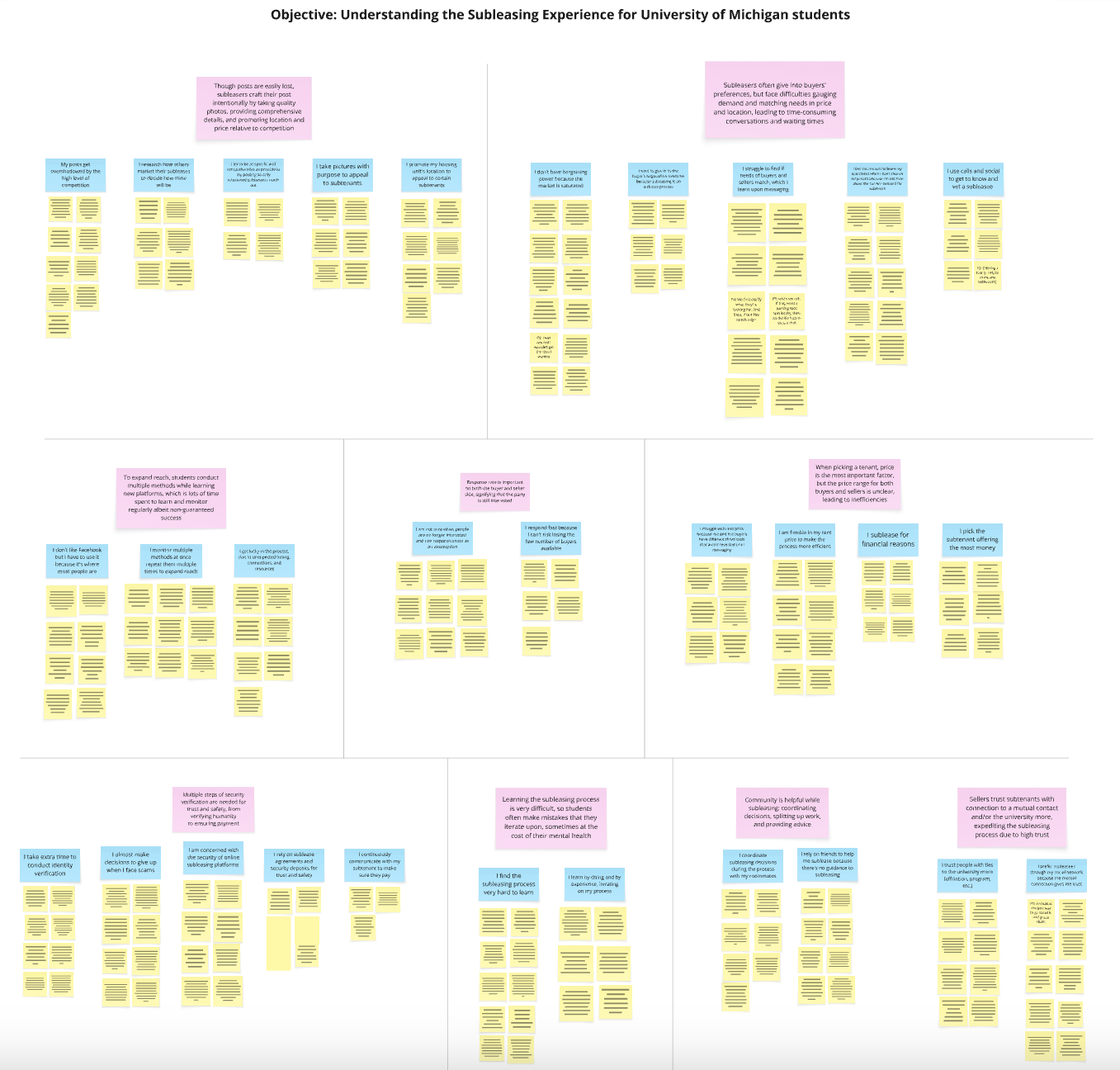
After conducting five interviews that follow the criteria above, I built an affinity diagram that resulted in 9 key themes:
- Promotional strategies
- Needs and demand alignment
- Simultaneous execution of methods
- Response rates
- Pricing
- Security
- Mutual trust
- Learning curve
- Community
Deliverables
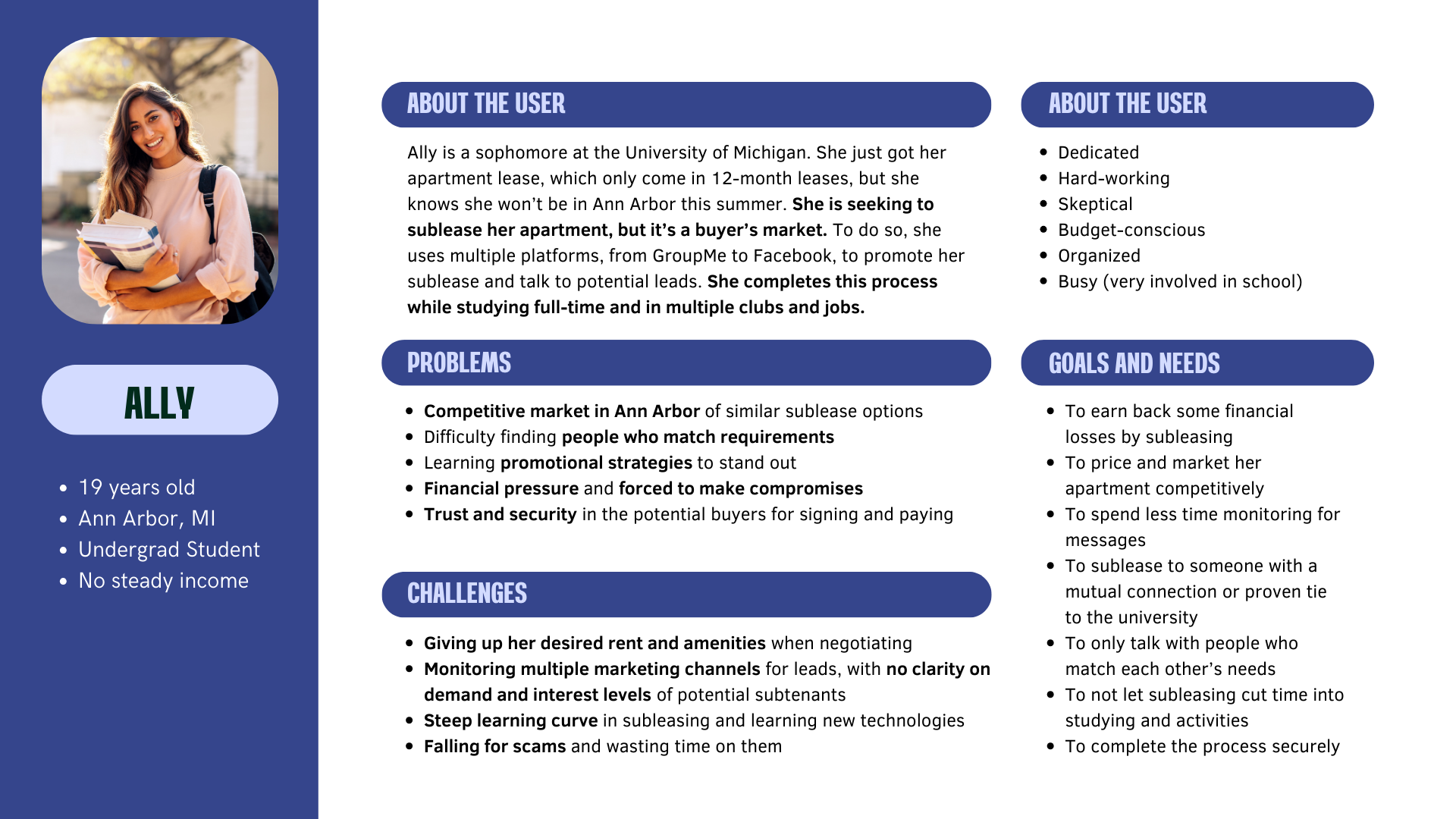
User Persona
Key insights:
- Depicted attributes of a college student subleasing in Ann Arbor, showcasing the need for efficiency in the process (particularly as a student) through the user profile and goals
- Described difficulty in learning the subleasing process, such as how to market the sublease competitively and complete the process securely, through problems, challenges, and needs
- Demonstrated frustration in lack of clarity on interest levels and demand levels through problems, challenges, and needs
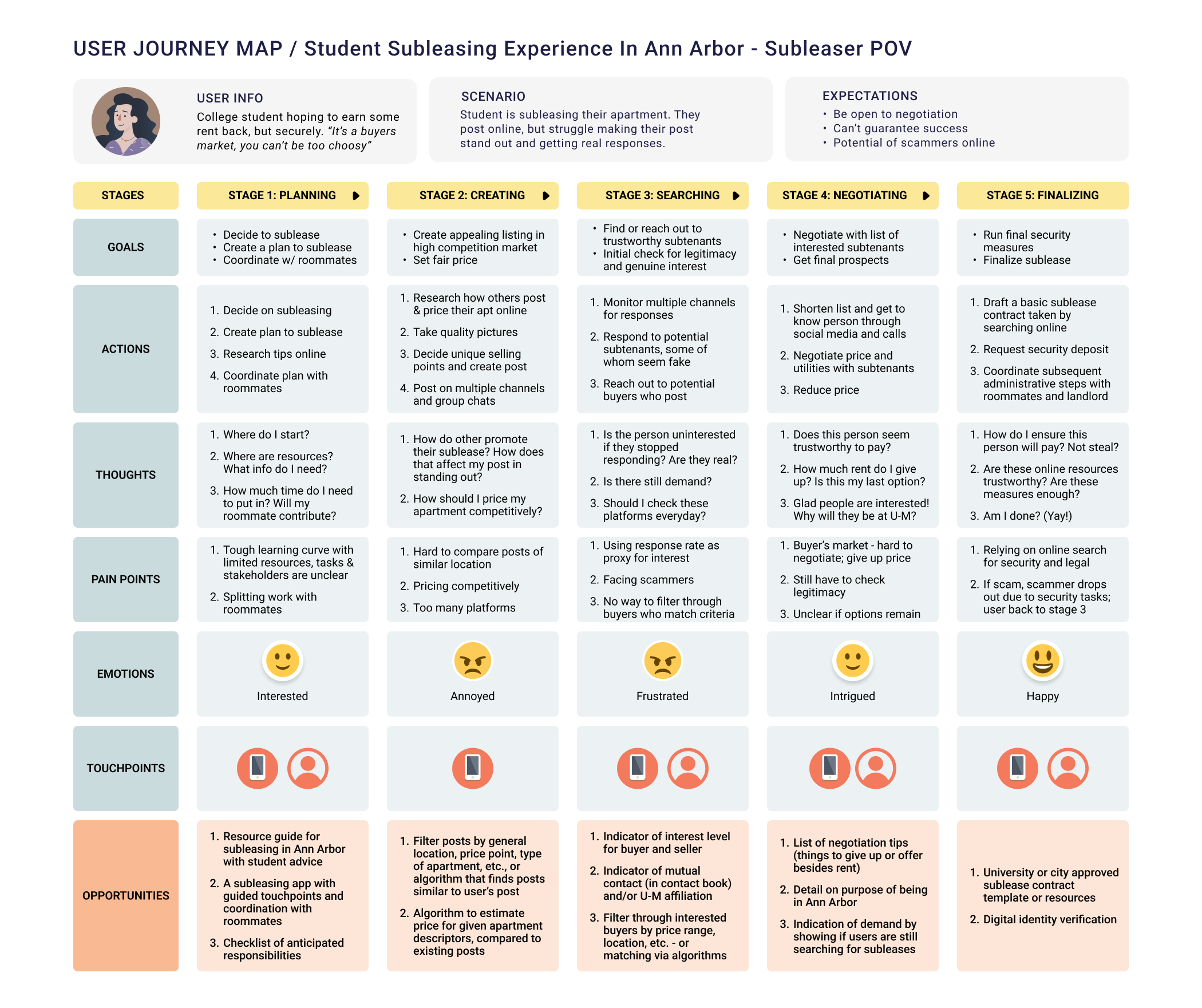
User Journey Map
Key insights:
- Described the long-term subleasing process going through 5 stages: (1) planning the subleasing process, (2) creating the sublease post, (3) searching for subtenants, (4) negotiating, and (5) finalizing the lease
- Respective to the 5 stages, incorporated the 9 findings accordingly:(1) hard learning curve, need for support; (2) struggle to curate promotional strategies and price competitively; (3) trusting mutual connections and fast response rates, executing multiple methods, aligning needs; (4) negotiating price, aligning demand; (5) enacting multiple security measures
Reflection
This was a great introduction to an end-to-end user research study. To improve the findings, I would…
- Reduce extraneous variables (e.g., 2 participants used Ross resources, impacting their experience)
- Consider context of participants (e.g., evaluating effect of cultural & financial background)
- Add users not represented by current sample (e.g., people who sublet houses, grad students, non-tech savvy individuals, people who are not my friends)
- Avoid selection bias (e.g., I interviewed my friends who are similar to me culturally and behaviorally) - this impacted my research by limiting perspectives and skewing pain points and level of motivation